
Guide
Barhi Dates: The Crunchy Date Worth Knowing
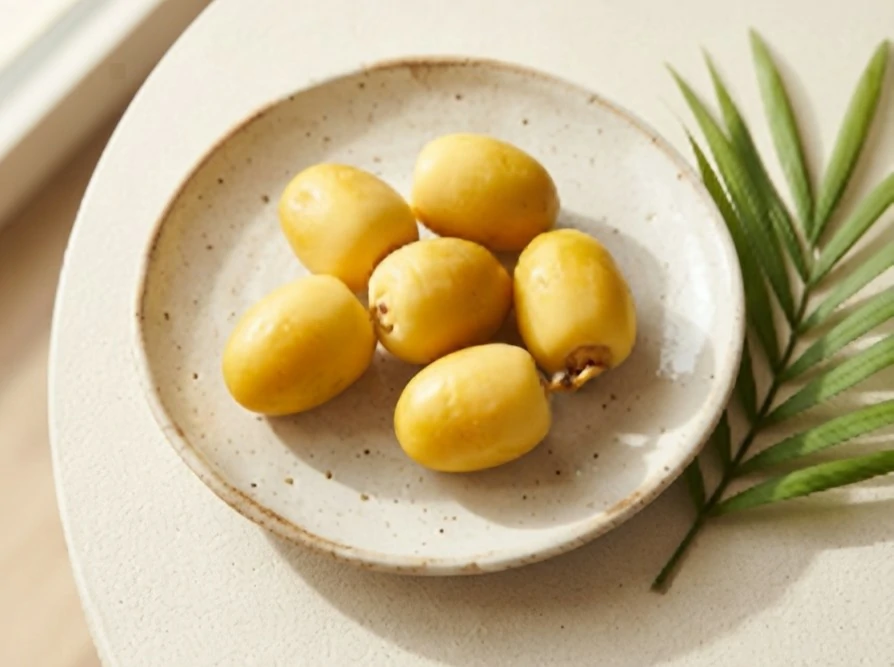
Yellow Barhi exists for four to six weeks and then vanishes. The khalal stage explained, why off-season Barhi is a different fruit, the honest price per pound, and the buying playbook I only learned on season three.
For two years in a row, I missed them. Every late summer, my Middle East market puts out boxes of yellow dates — crisp, firm, nothing like the chewy brown fruit I thought I knew — and by the time I got around to buying, the boxes were gone. Third year, I learned the pattern: yellow Barhi don’t stick around. They can’t.
This is a guide to the only date that behaves like a season, and how to not fumble it the way I did twice.
A note on method: the season window and pricing below come from published California date-industry reporting. The pattern of missing the season — twice — is my own.
First, the staging — because “fresh” is the wrong word
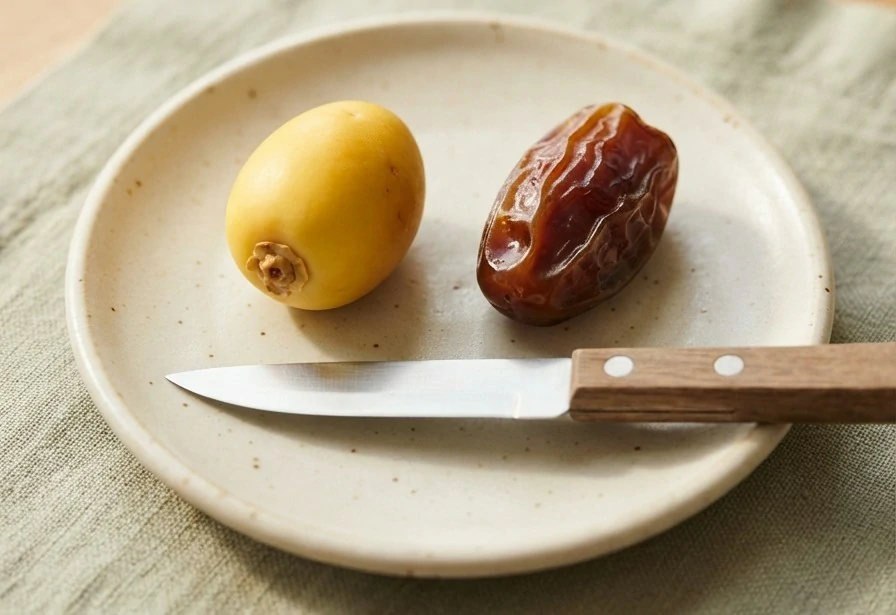
Dates move through named ripeness stages, and Saudi date-sector material defines them cleanly: khalal is the full-size, firm, crisp stage; rutab is the ripe, softer stage; tamar is the dried, shelf-stable fruit every grocery store sells year-round.
Barhi’s claim to fame is that it’s the variety people actually eat at khalal — the yellow stage. And the experience is genuinely strange the first time: the bite is crisp, like a firm apple, sweet but not caramel-concentrated, with none of the chew you’re braced for. If you’ve only met dates as sticky brown things, yellow Barhi at khalal tastes like a different fruit entirely, because functionally it is one.
Which is why I refuse to call it “fresh Barhi” in writing. Fresh can mean half a dozen things in this aisle. Name the stage: khalal or rutab. The word you’re looking for is the word on the stage, not the word on the front of the bag. The full variety profile lives on our Barhi page.
The window: four to six weeks, that’s the whole show
California’s Barhi season in the Coachella Valley runs roughly four to six weeks for the yellow khalal fruit, per a September 2026 California date-industry report. That short window is not a marketing scarcity trick — it’s the biology of a fruit that’s sold at a ripeness stage most varieties skip entirely.
The window also explains the impostors: off-season “Barhi” is usually frozen, or sold at a different ripeness stage entirely. Neither is the same product as peak-season yellow khalal, and stores don’t always say so loudly. Frozen Barhi is legitimately fine — but it’s a soft-thawed fruit, not a crisp one, and you deserve to know which one you’re buying.
| Market factor | What it means for you |
|---|---|
| Short season | Every price and product needs its date attached |
| Frozen/off-season | Not the same as peak yellow Barhi — different texture, different use |
| Ripeness stage | Ask or check: khalal (crisp) or rutab (soft)? |
What it costs, priced honestly
The 2026 snapshot: yellow Barhi retailed around $8–10/lb during the California season, with wholesale carton prices lower depending on pack and date (same California date-industry report). I keep wholesale and retail separate on purpose — averaging them produces a number that describes nothing. And every price here carries a season’s timestamp, because next year’s window will set its own.
Put in perspective against my standing price table (see the Medjool buying guide): that’s Medjool money for a fruit that exists for six weeks and can’t be pantry-stocked. Barhi is not a value play. It’s a season ticket.
The buying playbook I finally followed
- When yellow Barhi appears, buy same-week. My two missed years taught me the shelf life of regret.
- Buy what you’ll eat in one to two weeks — khalal Barhi is a high-moisture fruit and behaves like one. Cold storage is the move; the temperature numbers that decide this live in our date storage guide.
- Eat khalal cold, straight, or chopped into fruit salads. The crispness is the entire point — cooking it is a waste of the six weeks.
- Freeze some if you love it. Accept that thawed Barhi is a soft fruit; it’s excellent that way over yogurt, and it is not the same fruit, and that’s fine.
- Don’t confuse it with Zahidi — different variety. See below.
Verdict
Barhi is for you if: you like texture adventures, you eat seasonally on principle, or you want the one date experience that literally cannot wait for you.
Skip it if: you want pantry-stable sweetness for cooking and baking — that’s Medjool and Deglet Noor country (see the best dates for cooking guide), and they’ll be there in November. Barhi won’t.
Frequently asked questions
Is Barhi the same as Zahidi?
No — different varieties entirely. The yellow, crunchy khalal stage is Barhi’s commercial signature, not a general label for yellow dates. If a bin of yellow dates doesn’t name its variety and stage, ask before assuming.
What does khalal mean?
The full-size, firm, crisp ripeness stage — in Barhi, commonly yellow. It’s the stage before rutab (soft, ripe) and tamar (dried). Barhi is unusual in being widely sold and eaten at khalal.
Can I buy Barhi year-round?
Not as the yellow seasonal fruit — that window runs four to six weeks in the California season. Off-season you’ll find frozen Barhi or fruit at a different ripeness stage, which are related products, not the same one.
Sources: UC ANR postharvest references · California date-industry reporting on the Barhi season · Saudi date-sector material defining khalal and rutab