
Guide
Date Storage Guide: Fridge, Freezer, and Shelf Life
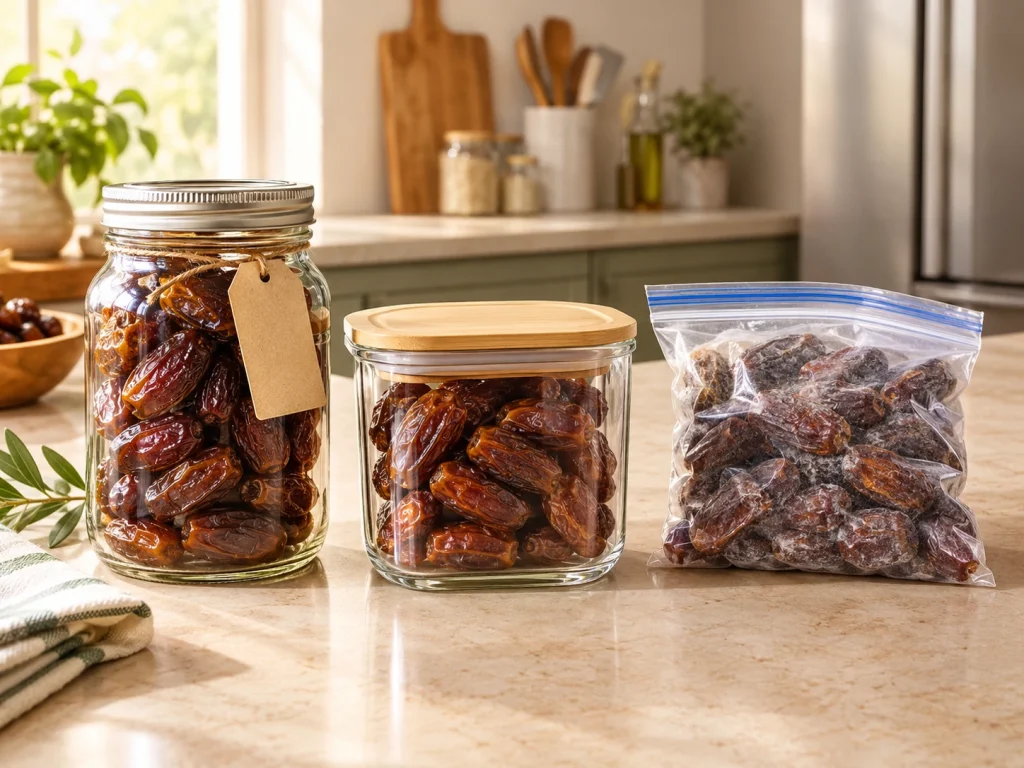
Pantry: a month. Fridge: eight months. Freezer: more than a year. The temperature table that decides where your dates live, the two-column test for old bags, and why a best-by date is not a safety cutoff.
Two weeks ago I pulled a bag of Deglet Noor from the back of my pantry — the shelf behind the rice cooker that functions as a pantry graveyard. The bag had no receipt, no memory, no pack date I trusted. I stood there holding it and realized I had opinions about date storage but no numbers.
So I looked up the actual postharvest research, and honestly, it rearranged my kitchen. The numbers aren’t subtle. Here’s the spine of everything below.
A note on method: the storage figures below come directly from published UC ANR and USDA FSIS postharvest research. The framing — what those numbers mean for an actual kitchen — comes from my own pantry, and I have said so where it matters.
The four temperatures that decide everything
For dates at about 20% moisture or less, the University of California’s postharvest material gives these quality windows (UC ANR, Harvesting and Postharvest Handling of Dates):
| Storage | Temperature | Published quality window |
|---|---|---|
| Pantry | 20°C / 68°F | ~1 month |
| Refrigerator | 4°C / 39°F | ~8 months |
| Cold storage | 0°C / 32°F | ~1 year |
| Freezer | −18°C / 0°F | More than a year |
Read that top row again, because I had to: the pantry gives you about a month. Not “a while.” A month of good quality at room temperature — and my kitchen runs warmer than 68°F for half the year because I refuse to argue with my wife about the thermostat. Every bag I’d ever “stored” in the cupboard was quietly aging at five to eight times the rate of the fridge.
The same UC material adds a variety twist that explains a lot: semi-soft dates like Deglet Noor and Halawi outlast soft varieties like Medjool and Barhee. The squishier the fruit, the faster it moves. My premium Medjool were the most perishable thing in the date drawer.
What the numbers look like on an actual calendar
| If I buy on… | Pantry deadline | Fridge deadline | Freezer |
|---|---|---|---|
| March 1 | ~April 1 | ~November | Next spring, easily |
| October 1 (post-Ramadan sale) | ~November 1 | ~June | A year out |
These are quality estimates from published research, not promises for every bag — moisture, cultivar, and packaging all shift the lines. But as planning numbers they’re transformative. A two-pound Costco Medjool haul (see my five-pack experiment) is not a pantry item. It’s a fridge item the day it comes home.
Pantry: honest about its limits
Pantry storage is fine for exactly one scenario: dates you’ll finish within weeks, in a sealed package, in a genuinely cool spot. Heat is the whole game — the cupboard above my oven was the worst real estate in the house, and I’d been keeping dates there for years because it was “convenient.”
Keep the package sealed against moisture and insects. And if the label gives storage instructions, the label wins over any guide, including this one.
Fridge: the practical middle
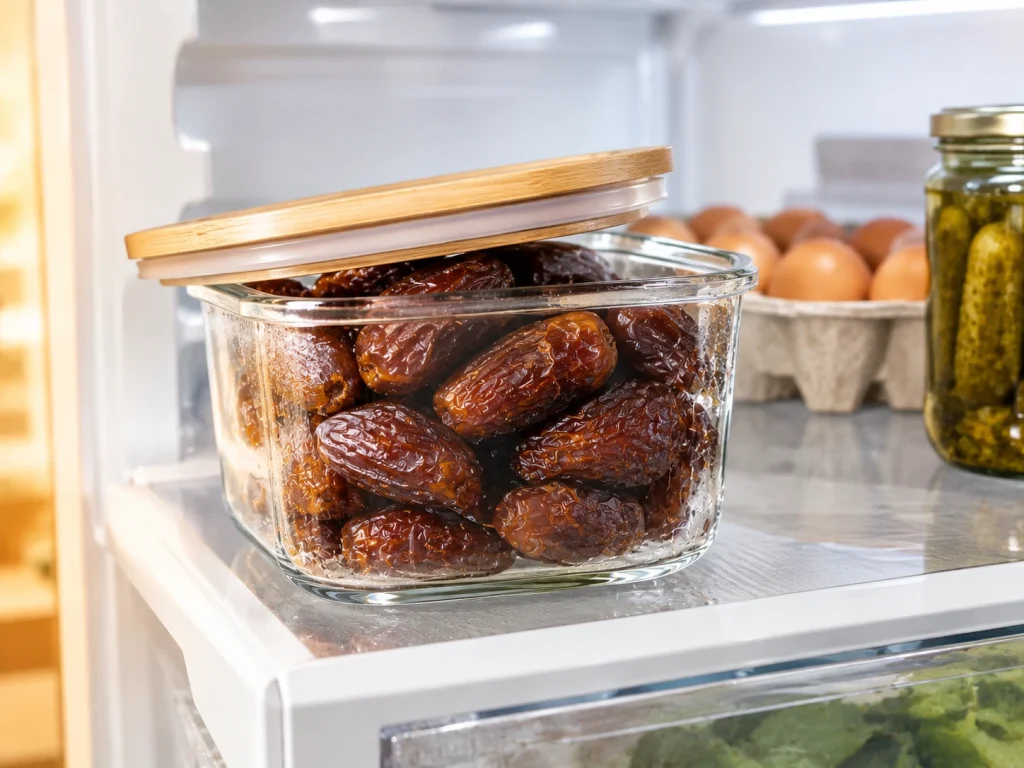
Eight months of quality for ~39°F is why my Medjool now live on the back shelf of the fridge — back shelf, not the door; the door swings warm every time someone wants a soda.
One thing nobody warned me about: dates absorb odors. An open bag shelved near the onions comes out tasting like the onions, and no research citation fixes that. Airtight container, non-negotiable. It also limits moisture exchange, which is what keeps the texture from drying at the edges.
Freezer: for people who buy like me
Freezing is the longest documented window — more than a year at 0°F — and the trick isn’t the freezing, it’s the portioning. I divide bulk purchases into bag-sized portions before freezing, press the air out, and lay them flat. Thaw what tonight needs; the rest stays frozen. Repeatedly opening one big bag to fish out dates defeats the entire exercise.
Texture after thawing? For cooking and blending, I can’t tell. For eating straight, soft varieties are marginally softer than fresh-opened — noticeable if you’re paying attention, irrelevant if you’re not.
The printed date is not what you think
USDA’s food safety service is clear on this: product dates generally concern quality, not safety (USDA FSIS, Food Product Dating). A “best by” that passed doesn’t mean the bag turned dangerous; it means the packer stopped vouching for peak quality. What I actually do: check the fruit, not the calendar — and follow the manufacturer’s handling instructions regardless.
Checking an old bag: the two-column test
| What I check | What it tells me |
|---|---|
| Surface | White dusty film = sugar crystals, harmless. Fuzzy or colored spots = mold, done |
| Smell | Caramel = fine. Fermented, alcoholic, “off” = done |
| Texture | Drier-but-fine vs. syrupy, slimy, or weirdly hard — the weird wins |
| Package | Broken seals, moisture inside, damage = quality risk regardless of dates |
The white coating deserves its own sentence because it saves bags: crystallized sugar is chemistry, not spoilage. If the smell is right and there’s no mold, I eat it.
My decision rule now
- Finished within a month → pantry, cool spot, sealed.
- Kept for months → fridge, airtight, back shelf.
- Bulk haul or post-Ramadan stock-up → freezer, pre-portioned.
That’s it. The research made my system simpler, not more complicated — which is usually the sign the research is good.
Frequently asked questions
Do I refrigerate Medjool?
Yes, always, once opened — and now before it, too. Softer varieties have shorter storage lives than semi-soft ones, and Medjool is the softest date most people buy. Mine live airtight on the fridge’s back shelf and honestly taste better cold anyway.
Is the printed date a safety cutoff?
No — USDA’s position is that product dating generally concerns quality, not safety. I still inspect before eating anything old, and I follow the package’s own storage instructions, because the packer knows how it was handled.
What is the white stuff on old dates?
Almost always crystallized sugar — harmless, and a sign of moisture migration, not rot. The actual warning signs are mold, a fermented or alcoholic smell, and texture that has gone somewhere strange.
Sources: UC ANR, Harvesting and Postharvest Handling of Dates · UC ANR, Small Scale Postharvest Handling Practices (6–12 months at 0°C or −18°C) · USDA FSIS, Food Product Dating