
Guide
Ajwa Dates: Origin, Texture, and How to Buy Authentic Ones
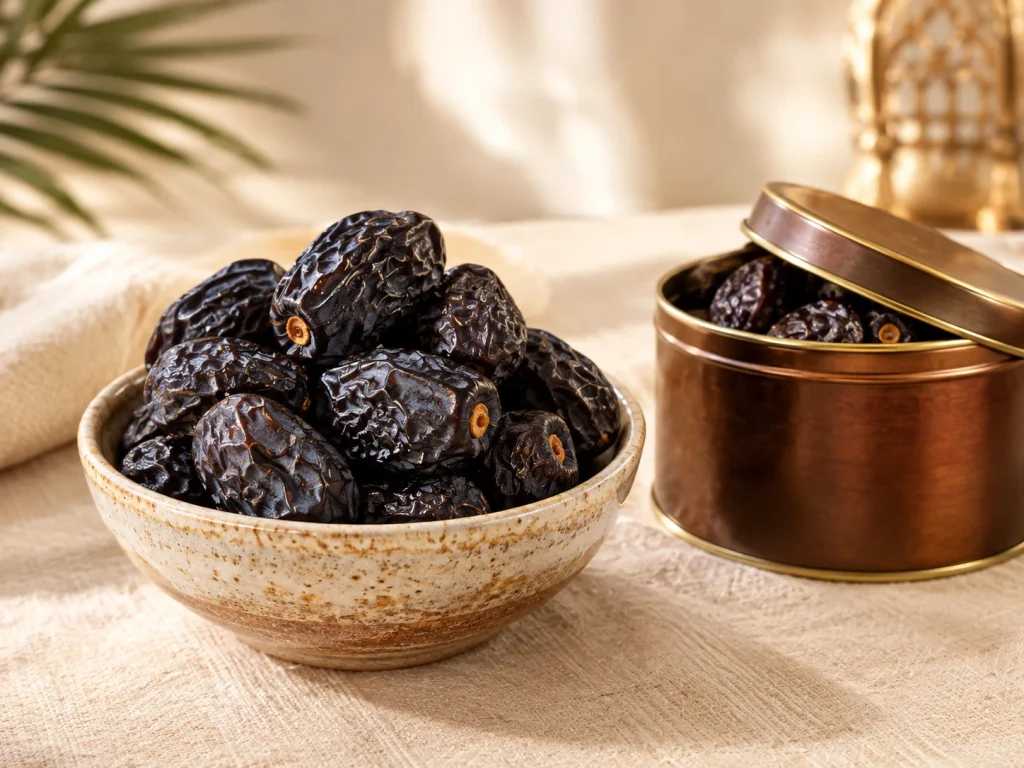
Ajwa is the date of Medina and the most overpriced thing in the aisle if you buy it for the wrong reason. What the premium really buys, how authenticity checks work, and when to walk away.
The bin said $24 a pound. Beside it, jumbo Medjool — fruit the size of small eggs — sat at $11.99. The Ajwa were a third the size, darker than my coffee, and twice the price of the biggest, softest dates on the shelf. I bought a quarter pound anyway, because I’d been recommending Ajwa as a gift for two years and wanted to finally interrogate the price tag properly.
Here’s what the investigation found, including the part of the answer that has nothing to do with flavor — and why that part is still, honestly, worth paying for.
Where Ajwa comes from
Ajwa is the date of Medina, Saudi Arabia. Saudi government agricultural material describes the mature fruit as dark to brown, medium-sized, oval, with characteristic fine surface lines. That’s the fingerprint you’re checking against at the shelf.
But let’s be precise about what origin tells you: the Medina association is why Ajwa exists as a premium category. It is not proof that every package labeled Ajwa contains Medina fruit. Origin is the story; the package is the evidence. More on that below.
The part honest guides struggle to say
For Muslim recipients, Ajwa carries an association no other date touches — it’s the variety praised in hadith collections, and in my house it’s the first tray emptied at every Eid gathering. My father-in-law photographed the jar box I gave him last Eid before opening it; the Ajwa jar was the one he reached for first (the full box breakdown lives in our best dates for gifting guide).
Now, the careful sentence: that cultural and religious weight is real value to the recipient, and it is not a quality metric. I don’t treat “sacred” as a tasting note, and I don’t treat the premium as a flavor claim. I treat it as what it obviously is: you are paying partly for fruit and partly for meaning. For the right recipient, meaning is worth it. For the wrong one, it’s a markup on small dark dates.
Ajwa vs. Medjool, side by side
| Ajwa | Medjool | |
|---|---|---|
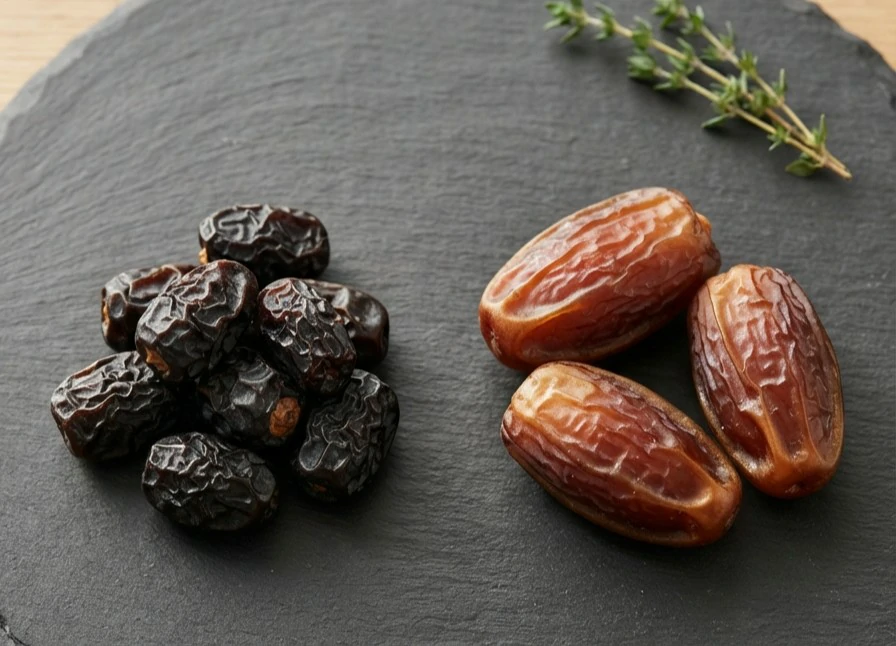
| Size | Small-medium, oval | Walnut-sized, the giant of the shelf |
| Color | Near-black, dark brown | Amber-caramel |
| Texture | Denser, drier, fine-lined skin | Soft, juicy, glossy |
| Sweetness | Mellow, darker flavor | Loud caramel sweetness |
| Price (my snapshots, late 2025) | ~$20–28/lb | $6.50–12/lb |
| Role | Prestige, gifting, tradition | Crowd-pleasing, everyday indulgence |
The sweetness row is where people mispredict: Ajwa is not “more” than Medjool — it’s less sweet, drier, more restrained. People expecting a super-Medjool get a quieter date and sometimes feel cheated. That’s a mismatch of expectations, not of quality.
The authenticity problem, handled honestly
I can’t hand you a test that proves a package is genuine Ajwa — no single check does that, and anyone who claims one is selling something. What you have is a stack of signals, each weak alone, strong together:
| Signal | What it can and can’t show |
|---|---|
| Named origin + traceability | Supports the story; not proof alone |
| Importer/seller information | Complete, findable info = accountability |
| Variety description matches (dark, oval, fine lines) | A cross-check, not a fingerprint |
| Price sanity | Too-cheap Ajwa is a reason to investigate, not automatic proof of fake |
My rule after comparing packages: vague origin + missing seller info + a suspicious price is a three-strike pattern I walk away from. One strike alone? Just a question mark.
Price without false precision
Retail Ajwa moves fast, especially around Ramadan, so every price I quote carries its own timestamp. My method: compute $/lb from the package’s net weight (never compare sticker prices across different bag sizes), and record the date I recorded it.
Ramadan pricing is real and I’ve watched it: my local market’s Ajwa went from $22 to $28 a pound in the last ten days of Ramadan — about +27%, measured from the same seller (the receipt table lives in our gifting guide). That’s a snapshot, not a universal seasonal multiplier. But it’s why my standing advice is buy Ajwa three weeks before Eid, when prices are calmer and stock exists. By Eid week you’re choosing between leftovers and overspending — I’ve done both, and both sting.
Verdict
Buy Ajwa when: the recipient fasts or values tradition (Ramadan, Eid, Umrah returns), you’re gifting up in formality, or the recipient genuinely loves the dark, restrained profile.
Skip it when: you want sweet-and-soft snacking (Medjool does that at a third the price), you’re buying in bulk for cooking (a waste of a prestige date — that’s Halawi‘s job), or the package fails the three-strike test.
The middle path, if $24/lb stings: Safawi or Khudri deliver the dark-date experience at dark-discount prices. Not Ajwa. But not pretending, either.
Frequently asked questions
How can I check whether Ajwa is authentic?
Three tangible checks: stated origin with traceability, package description matching the variety’s actual characteristics (dark, oval, fine surface lines), and complete importer or seller information. None is conclusive alone — the question is whether the whole picture holds together.
Should Ajwa be refrigerated?
For anything beyond a few weeks, yes — same rules as other dates, and the storage numbers that decide it live in our date storage guide. After opening, airtight and cold. And follow the package’s own instructions first.
Is Ajwa sweeter than Medjool?
My palate says the opposite — it reads drier, less sweet, more restrained. Cultivar, ripeness, and storage all shape this, so I’ll say it as opinion: if you’re buying Ajwa expecting louder sweetness, you’ve got the comparison backwards.
Sources: Saudi Ministry of Environment, Water, and Agriculture · FAO background on date-palm production · USDA handling references