
Guide
Best Dates for Baking: A Practical Variety Guide
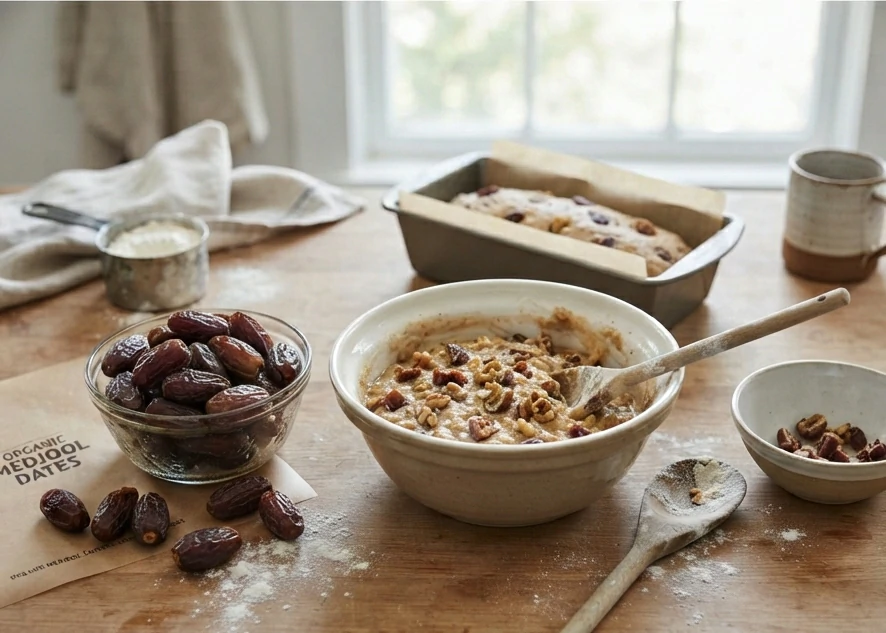
A date that is perfect straight from the bag can ruin a bake. The right choice depends on moisture, texture, and whether you want the fruit to disappear into the batter or hold its shape. Here is how to match the variety to the job.
Not all dates behave the same way in a recipe.
Some hold their shape. Some melt into the batter. Some stay chewy. Some turn to paste before you even mix them.
The date you’d happily eat out of the box could be the exact date you’d regret putting in the oven.
The best date for baking is the one whose texture and moisture match the job. Learn what each variety brings to the bowl, and baking with dates stops being guesswork.
What does “date baking” actually cover?
Dates appear in baking as a sweetener, a filler, or a flavor. The intended role changes what you should pick:
- Sticky, caramel-like sweetness: for energy bars, no-bake bites, and date-based caramel
- A soft, moist binder: for brownies and cakes where dates replace sugar or fat
- A structural bite: for breads, muffins, and scones
- A puree or paste: for fillings, frosting, and binders
Each use wants a slightly different texture.
Two varieties do most of the work
Medjool and Deglet Noor cover nearly all baking needs. They’re common, easy to find, and behave in predictable ways at baking temperatures.
Check out our side-by-side Medjool and Deglet Noor guides for the full breakdown.
Medjool: the baking MVP
Medjool is soft, buttery, and naturally sticky. In the oven it dissolves and integrates more readily than a firmer date, which makes it excellent for:
- Date paste
- No-bake energy bars
- Date caramel
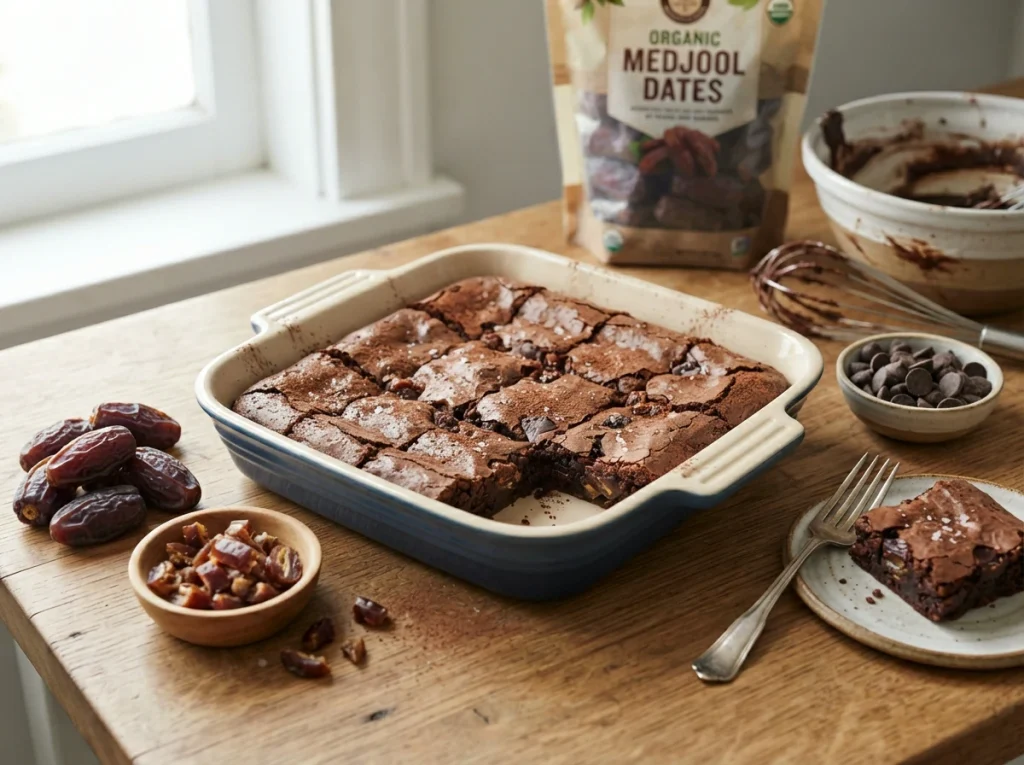
- Brownies and cakes
- Filling inside stuffed dates
Because Medjool is large and soft, you can pit it by hand in seconds, and it purees with minimal effort. If a recipe calls for “dates” generically, Medjool is the safest choice.
Deglet Noor: the texture keeper
Deglet Noor is firmer, meatier, and less sticky. It keeps its shape when baked, which makes it better for:
- Date nut bread
- Muffins and scones
- Oatmeal and granola squares
- Diced fruit in cookies
- Anything where you want discreet date pieces
Its firmness also means it’s more likely to stay separate from the batter, so you get pockets of fruit rather than a uniform paste.
The moisture rule
Baking is dependent on ratios. Dates contribute both sugar and moisture, and the ratio changes the result.
A soft Medjool can replace up to 25% of the sugar in a recipe with a more molasses-like, less sweet finish. You’ll want to reduce liquid elsewhere when you do. King Arthur Baking covers similar ratio guidance for fruit-based sweeteners if you want to explore the technique further.
A firmer Deglet Noor contributes less water, so it’s a better choice when the batter is already liquid-heavy and you don’t want a soggy crumb.
Can you swap Medjool and Deglet Noor in baking?
Yes, but with consequences.
- Swapping Medjool for Deglet Noor: the result will be softer, sweeter, and stickier. Reduce liquid slightly.
- Swapping Deglet Noor for Medjool: the result will be firmer and less uniform. Add a few tablespoons of liquid.
Neither swap ruins a recipe. Both change the texture, so adjust moisture to match.
Pitted vs. unpitted for baking
Buying pitted dates saves time but costs per-ounce. Unpitted fruit is cheaper but you must pit everything yourself.
For baking, most recipes expect pitted dates. If yours aren’t, remove the pit first — baking won’t soften it enough to skip.
Whole vs. chopped vs. pureed
How you cut dates changes their role:
- Whole: keep them intact for stuffed or wrapped recipes where a date should stay a date.
- Chopped: distribute flavor without dominating. Deglet Noor is ideal since pieces hold their shape.
- Paste or puree: add caramel sweetness, moisture, and a natural binder (energy bites, brownies, cheesecake crusts).
Making date paste: the simple version
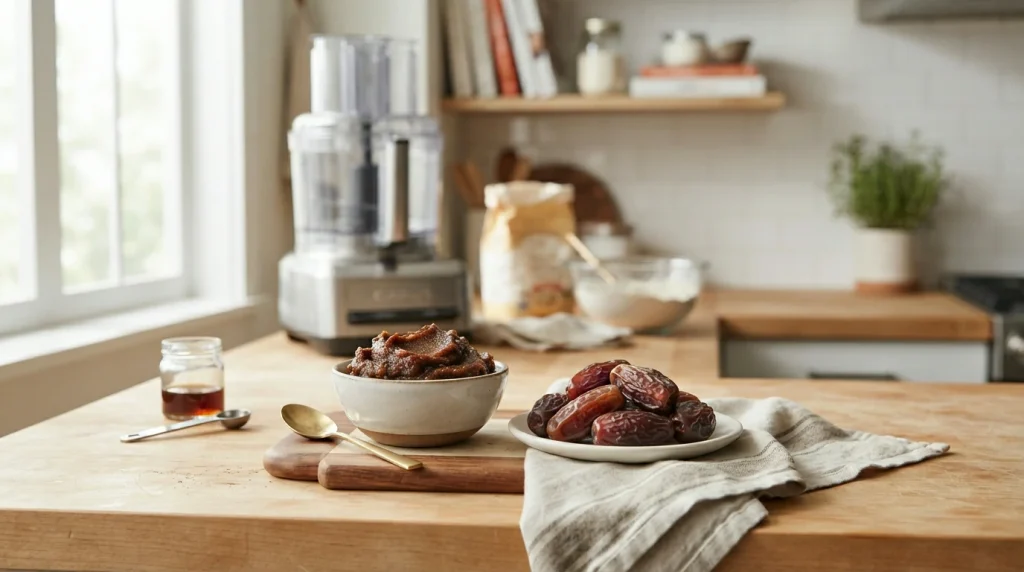
Date paste is the workhorse of date baking. Soak pitted Medjool briefly in hot water, then blend with a tablespoon or two of that water until smooth. You’ll get a thick, naturally-sweet paste that behaves like a wet sugar.
For a firmer texture on the same base, try our no-bake date energy balls recipe to see a whole-date application.
Storage before baking
Old, dried-out dates ruin baking. Fresh dates should feel soft and glossy. If they feel leathery or grained sugar has crystallized, they’re past peak.
Keep dates in the fridge or freezer until you’re ready to mix, and bring them to room temperature before baking. Cover details are in our date storage guide.
Can you bake with any other variety?
Yes. If you have Barhi, Khadrawy, Halawy, or Zahidi on hand, use them. They lean more like Medjool or Deglet by texture, so follow the corresponding swap advice above.
The point isn’t a single “right” date; it’s choosing a variety whose moisture matches your bowl.
Recipes by role
- Want a chewy bites: Deglet Noor with oats and nuts
- Want a soft “caramel” layer: Medjool puree
- Want fruit studding in quick bread: chopped Deglet Noor
- Want a replace-all binder: Medjool paste
What we tell shoppers
When we check a date listing for baking, we look at the same traits you would: variety, freshness, pitting, and price per ounce. A moist Medjool priced per ounce within range of comparable listings is a strong baking buy even when it’s not the cheapest label on the shelf.
Compared by price per ounce, premium baking dates usually cost more than bulk bags, but they also degrade less in the oven. Check results on our live Baking Date Finder if you want current picks.
The kernel
Dates are forgiving. Imprecise swaps still bake into something good. But the best date for baking is the one matched to the job: Medjool when you want sticky caramel and integration, Deglet Noor when you want structure and defined pieces.
Frequently asked questions
Do pitted dates work the same as unpitted in baking?
Yes, once you remove the pits. Pitted dates save prep time; unpitted cost less per ounce but take minutes of manual labor. For bulk baking, leftovers should be pit-free before you blend or chop.
How much sugar do dates actually add to a recipe?
Dates are roughly 60-70% sugar by weight, mostly fructose and glucose with some fiber. As a 1:1 sugar replacement they behave differently because dates also add water and fiber, so adjust the liquid and expect a less crisp, more moist result.
Can I make date paste without a food processor?
Yes. Soak pitted Medjool in very hot water for 15 minutes, then mash with a fork or potato masher until smooth. It won’t be as silky as a blender version, but it works for stirred-in batters and binders.