
Guide
How to Buy Dates Online in the US Without Overpaying (2026 Guide)
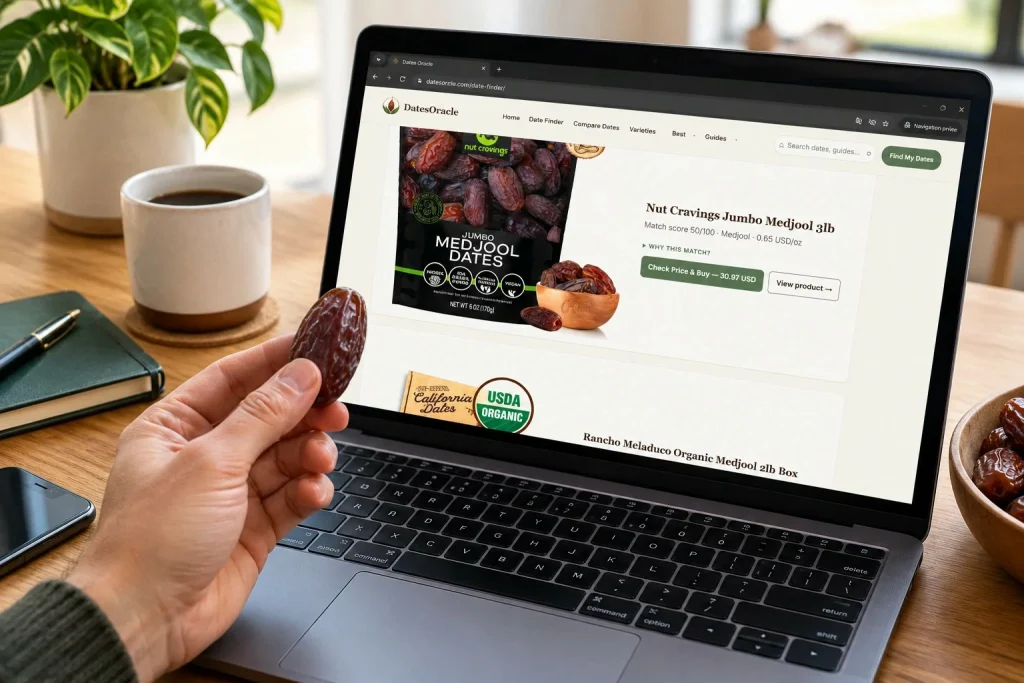
Buying dates online in the U.S. is not hard — but it is easy to overpay. Package weight, shipping, pitting, and marketplace seller all change the real price. Here is the checklist we use before recommending a listing.
Buying dates online looks easy until you compare two packages that seem almost identical.
One says $12.99. Another says $18.99. One has 12 ounces. The other has two pounds. One is pitted. The other isn’t. One ships for free, while the cheaper-looking option adds shipping at checkout.
Suddenly, the price printed on the product page isn’t enough.
This is especially true with dates because online listings mix varieties, sizes, origins, package weights and quality grades in ways that make quick comparisons surprisingly difficult.
If you’re buying dates online in the U.S., the goal isn’t to find the package with the lowest headline price.
It’s to find the product that gives you the right quality, quantity and delivered value for what you actually want to do with it.
Start with the variety, not the price
Before comparing prices, decide what kind of date you’re looking for.
A two-pound box of Deglet Noor shouldn’t be compared directly with a one-pound box of premium Medjool simply because both are listed under “dates.”
Medjool is typically larger and softer. Deglet Noor is generally smaller and firmer. Other varieties can have their own flavor, texture and price characteristics.
If you’re buying dates for snacking, you may care most about softness and sweetness.
For baking, consistency and texture can matter more.
For gifting, appearance and packaging may justify a higher price.
The cheapest date is only a bargain if it is actually the date you wanted.
Package weight changes everything
This is the mistake I would expect most shoppers to make when buying online: comparing package prices without normalizing the weight.
Suppose one listing is:
$19 for 2 lb
and another is:
$12 for 12 oz
At first glance, the second product looks cheaper.
But two pounds equals 32 ounces.
That means:
- $19 ÷ 32 oz = about $0.59 per ounce
- $12 ÷ 12 oz = $1.00 per ounce
The $12 package costs less at checkout, but the larger package is substantially cheaper by weight. Our price-per-ounce methodology explains the normalization we apply before comparing any two listings.
The same calculation works whether you’re comparing supermarket products, marketplace listings or specialty date sellers.
Then check what the price includes
Online shopping introduces another problem: the product price isn’t always the final price.
Before deciding between two listings, check:
- Shipping cost
- Minimum order requirements
- Subscription pricing
- Coupons or automatic discounts
- Membership-only pricing
- Taxes
- Delivery estimates
A $9.99 package that becomes $16 after shipping isn’t necessarily a better deal than a $12.99 package with free delivery. The FTC’s consumer guidance on online shopping covers the disclosure rules merchants are expected to follow — useful context when a listing feels deliberately vague.
This becomes particularly important when buying a single small package.
For larger orders, shipping may have much less impact on the effective cost per ounce.
Don’t let a giant product photo do the selling
Online date listings are heavily visual.
A close-up of enormous, glossy Medjool dates can make a product look exceptional before you’ve read anything about it.
The photograph is useful, but it isn’t enough.
Look for the actual product specifications.
You want to know:
What variety is it?
How much does the package contain?
Are the dates pitted?
Where are they from?
What ingredients are listed?
How should they be stored?
Who is actually selling the product?
If those details are missing, the listing becomes harder to compare with anything else.
“Organic” doesn’t tell you everything
Organic certification can be meaningful, but it doesn’t answer every question about a date product.
An organic Medjool can still vary in size, softness, origin, packaging and price.
Likewise, a conventional product can be perfectly suitable for someone who doesn’t specifically seek organic certification.
Treat organic status as one product attribute, not as a shortcut for overall quality.
If you’re paying a premium for organic dates, compare that premium against the rest of the product. We broke down the full organic premium across both varieties in our Are Organic Dates Worth It? guide.
Look at the seller, not just the marketplace
A familiar marketplace name doesn’t automatically mean every listing is identical.
The seller can matter.
Check whether you’re buying directly from the retailer, from a specialist food company, or from a third-party marketplace seller.
Also look at:
- Seller rating
- Return policy
- Shipping origin
- Product description
- Recent availability
- Customer reviews
For food products, unusually old reviews can be less useful than they appear. A listing may remain active while the seller, packaging, harvest or fulfillment arrangement changes.
That doesn’t make reviews useless. It means they should be treated as one part of the decision.
Pay attention to the exact product
This matters particularly when a retailer uses one page for several sizes.
You may click a listing advertised as a 2-pound package and discover that the page contains:
- 12 oz
- 24 oz
- 32 oz
- Organic
- Conventional
- Pitted
- Unpitted
The price shown on the page may change when you select a different option.
For an accurate comparison, the product and the offer have to match.
At DatesOracle, that means an offer should be associated with the actual product characteristics rather than simply the retailer’s general product page — the same approach we describe in our data sources and verification methodology.
For shoppers, the practical lesson is simpler:
Check the selected size before you compare the price.
Amazon isn’t automatically cheaper
Amazon and other large marketplaces can be convenient places to buy dates, but convenience and value are not the same thing.
A marketplace can contain several sellers offering the same or similar products at different prices.
You may also encounter:
- Prime pricing
- Coupons
- Subscribe & Save
- Third-party sellers
- Different package sizes
- Different delivery dates
So don’t compare “Amazon” with “Walmart” as if each were a single product.
Compare the actual offer. You can do this directly using our compare tool, which normalizes size, pitting, and price per ounce automatically.
The question isn’t:
Where should I buy dates?
It’s:
Which specific offer gives me the product I want at the best delivered value?
When a larger package is actually cheaper
Buying in bulk can be attractive with dates because they store reasonably well when handled correctly.
But larger isn’t automatically better.
A two-pound package makes sense if you eat dates regularly, bake with them, or share them with a household.
It makes less sense if you only eat a few dates occasionally.
The cheapest price per ounce doesn’t matter much if half the package sits unopened or eventually loses quality.
This is one place where “best value” and “lowest unit price” are not always the same thing.
Read the reviews differently
Don’t just look at the star rating.
Search the reviews for the characteristics you actually care about.
For dates, useful phrases might include:
- soft
- dry
- fresh
- chewy
- hard
- pits
- small
- large
- sticky
- packaging
- mold
- shipping
A product with thousands of positive reviews isn’t necessarily the right product for someone who specifically wants very soft Medjool dates.
Reviews become more useful when you ask a narrow question of them.
Watch the harvest and storage information
Dates can be stored for a considerable period, but storage conditions still matter.
If a seller provides harvest information, packing dates or storage recommendations, read them.
This information becomes especially relevant when you’re buying a premium product where freshness and texture are part of what you’re paying for.
If the listing provides no meaningful information about the product’s condition or storage, be cautious about paying a large premium based only on photographs and marketing language.
A better way to compare two listings
Imagine you’re choosing between two products.
Product A
- Medjool
- 2 lb
- Pitted
- $18
- Free shipping
Product B
- Medjool
- 12 oz
- Pitted
- $11
- $5 shipping
Product B has the lower product price.
But after shipping, you’re paying $16 for 12 ounces.
Product A costs $18 for 32 ounces.
That is a completely different comparison.
The useful number isn’t $18 versus $11.
It’s the effective cost per ounce.
And if the products differ in size, quality, variety or preparation, price per ounce is only the starting point—not the final decision.
Three things I would check before clicking Buy
When I’m looking at an online food listing, I want the decision to survive beyond the first impression.
For dates, that means checking three things:
First: Is it the right product?
The variety, weight and preparation should match what you intended to buy.
Second: Is the price genuinely comparable?
Normalize the weight and include shipping where appropriate.
Third: Is the listing trustworthy?
Look for a clear seller, detailed product information, reasonable reviews and sensible storage information. For how we handle the commercial side of outbound links on our own site, see our affiliate disclosure.
If a listing passes those checks, you’ve already avoided most of the easy mistakes.
When paying more can make sense
There are legitimate reasons to pay more for dates.
You might want:
- Larger Medjool fruit
- Certified organic production
- A specific variety
- Premium packaging for gifting
- A particular origin
- Better grading or selection
- A retailer you already trust
The mistake is assuming that a higher price automatically means a better product.
Paying $18 instead of $10 should buy you something you actually value.
If you can’t identify the difference, compare again.
The simplest online buying strategy
You don’t need a spreadsheet every time you buy dates.
Just slow down for about a minute.
Find the variety.
Check the weight.
Check whether they’re pitted.
Look at the ingredient list.
Check shipping.
Calculate the price per ounce.
Then compare the actual product—not just the retailer name.
That small amount of work can turn a confusing collection of online listings into a much easier decision. If you want a starting point, the Date Finder ranks current products by variety, texture, sweetness and budget without requiring you to normalize every listing manually.
And that’s ultimately what a useful date comparison should do: make the buying decision clearer without pretending that the cheapest number on the screen is always the best deal.
Frequently asked questions
Is it cheaper to buy dates on Amazon or a specialty site?
It depends on the specific offer, not the platform. The same product can be priced differently across marketplace sellers, and shipping rules change the effective cost per ounce. Compare the offer, not the retailer name.
How do I know if an online date listing is trustworthy?
Look for a clear seller identity, detailed product specifications (variety, weight, origin, pitting), accurate current pricing, and sensible storage guidance. Vague listings with no weight or seller information are hard to compare fairly.
Do date prices change seasonally?
Yes. Date harvests occur in late summer and fall, and prices can shift with supply, origin, and retailer promotions. A price you saw six weeks ago may not match what is listed today.